Quick Answer To replace your hot water system under the NSW Home Energy Saver loan for hot water, first check […]
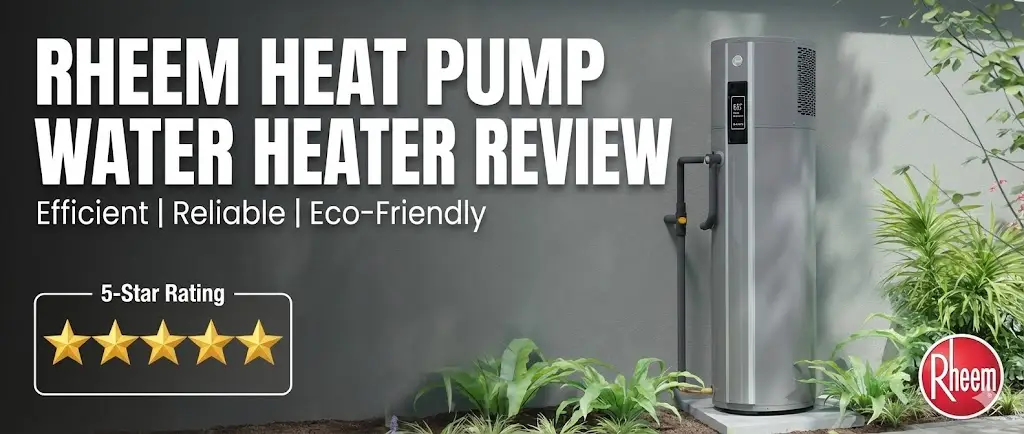
Power bills linked to heating water have long been a silent killer of household budgets, consistently ranking as the second-largest segment of home energy use in Australia.
For the average Aussie family, water heating accounts for a massive 15% to 30% of the total electricity bill, depending on location and system type.
In high-consumption areas like Perth, this figure can soar even higher. The choice of a hot water system, therefore, is not a minor appliance purchase—it’s a long-term financial strategy.
The Rheem heat pump promises to completely shift this financial burden.
Rheem is an Australian manufacturing leader with over 85 years of history in the hot water industry.
This experience makes it one of the most trusted and recognisable names for reliable systems built for local conditions.
The company’s goal with the AmbiPower is to bridge its legacy of durability with the urgent demand for energy efficiency.
It matters because it offers Australian homeowners a proven and strong system to drastically cut hot water energy consumption, which accounts for up to 30% of household power bills.
Furthermore, Rheem partners extensively with plumbers and renewable energy installers across the country.
It ensures there are enough systems and experts for local installation, plus a strong after-sales support via its established national service network.
In short, choosing the Rheem brand means investing in a product backed by the largest and most reliable support system in the Australian market.
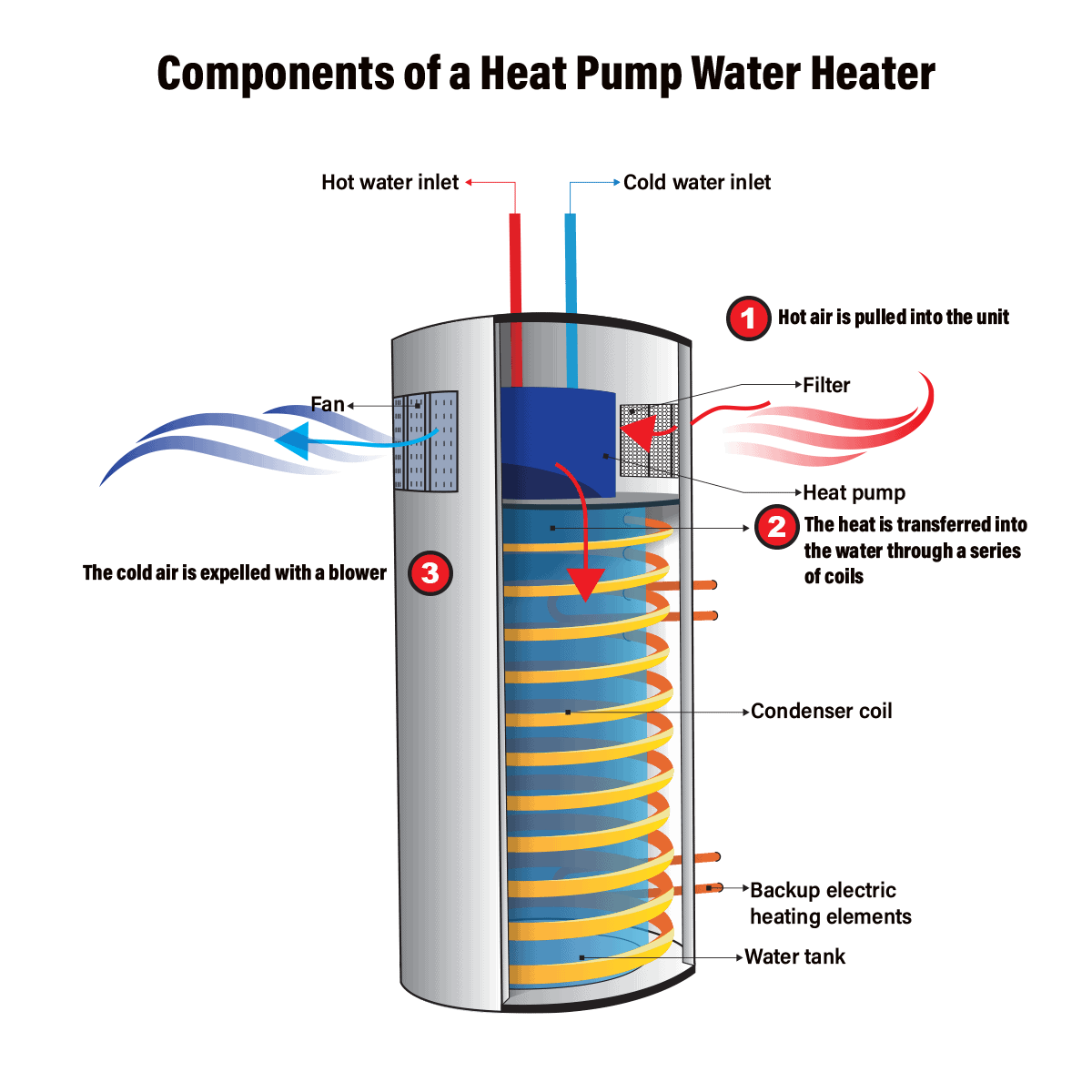
A heat pump operates on a completely different principle from the electric element it replaces. Think of the Rheem heat pump as an air conditioner on a reverse cycle.
Here is the simple step process:
The effectiveness of this process is measured by the Coefficient of Performance (COP).
The Rheem AmbiPower 280e achieves a maximum COP of 5.2.
This means that for every 1kW of electricity used to run the compressor, the system delivers an incredible 5.2kW of heating power to the water.
This is how it achieves over 400% efficiency compared to a standard electric heater.
🟥 Top-Tier Thermal Efficiency (COP of 5.2): The primary selling point is the AmbiPower’s exceptional Coefficient of Performance (COP) of up to 5.2. This places it at the peak of integrated heat pump efficiency in Australia.
🟥 Durability and All-Climate Operation (Down to -6 degrees Celsius). Rheem engineers its products to handle the full spectrum of Australian climates. This minimises the need for the less-efficient backup electric element in cold weather.
🟥 EcoNet enabled: This is similar to having a smart and energy-efficient assistant. It is easy to monitor and control your heat pump through this EcoNet app.
🟥 Brushless DC condenser motors (BLDC): The motors are set in the efficient manner. They’re quiet and keep your system running well for years.
🟥 The Power of the National Network: Ultimately, the biggest stand-out feature is the backing of the Rheem organisation. This guarantees that homeowners benefit from the most established supply chain in the country.
PlusOne® diagnostic & Bluetooth® 1 connectivity: This combination makes the system’s inspection and troubleshooting easy.
🟥 Variable speed scroll compressor & inverter drive: This feature really adapts to your heating and cooling requirements in real time.
🟥 Swept Wing Fan technology: For Aussies who love quiet heat pumps, the Rheem option is the best. It is designed to minimise noise significantly.
🟥 7 mm condenser copper coil 2: This coil offers better heat transfer which means better performance.
🟥 Inverted reversing valve: This feature helps your system switch between cooling and heating.
AmbiPower MDc- 180 Heat Pump (in R513a) and AmbiPower 5kW Split Heat Pump System — Which One Suits You?
Rheem offers several configurations to suit different household sizes and site requirements.
We focus on two primary models that cater to distinct segments of the market: the compact and all-in-one MDc-180 and the high-capacity and space-saving 5kW Split System.
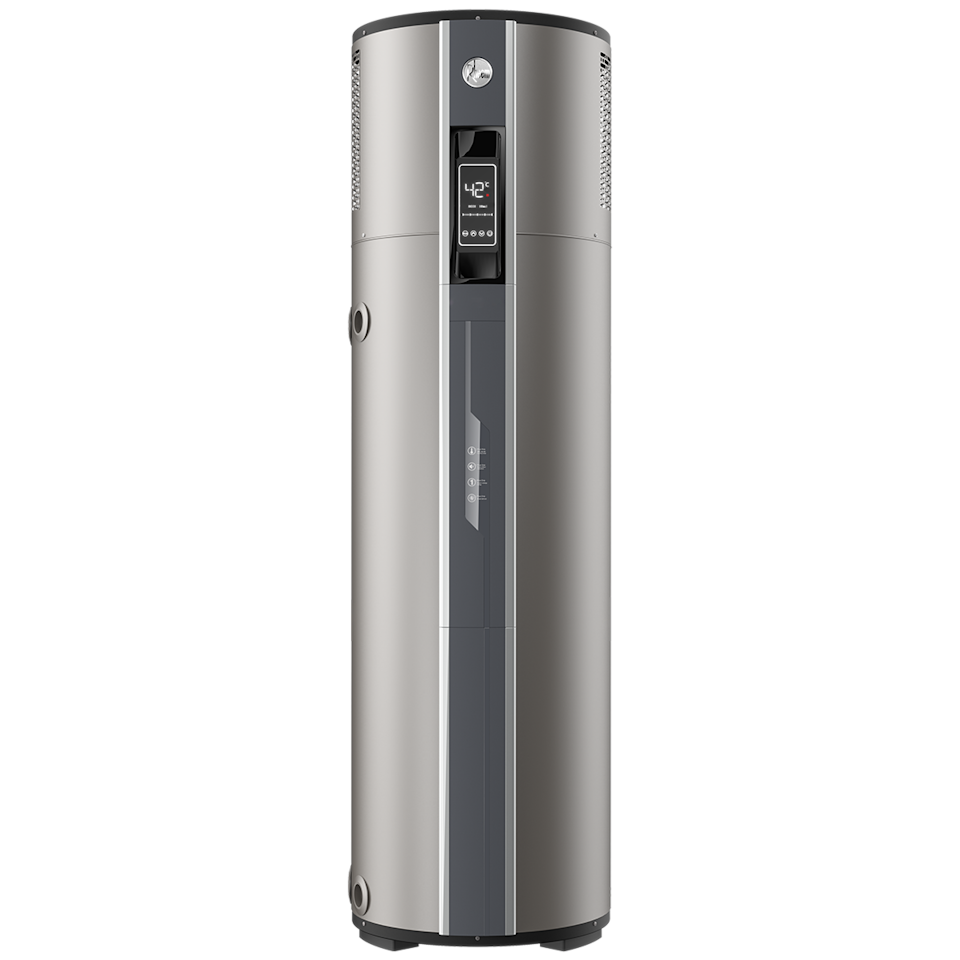
The MDc-180 is Rheem’s next-generation, integrated 180-litre heat pump, designed as a direct, drop-in replacement for traditional electric tanks in small-to-medium households.
It prioritises a small footprint and exceptional cold-climate performance.
Specifications: Rheem Ambipower MDc- 180 Heat Pump (in R513a)
What we like about the MDc-180 Heat Pump (in R513a)
What could be better
✔️ Best for: Small households (1-4 people) or those replacing an electric system in a very cold climate where space is a challenge and reliability below zero is paramount.
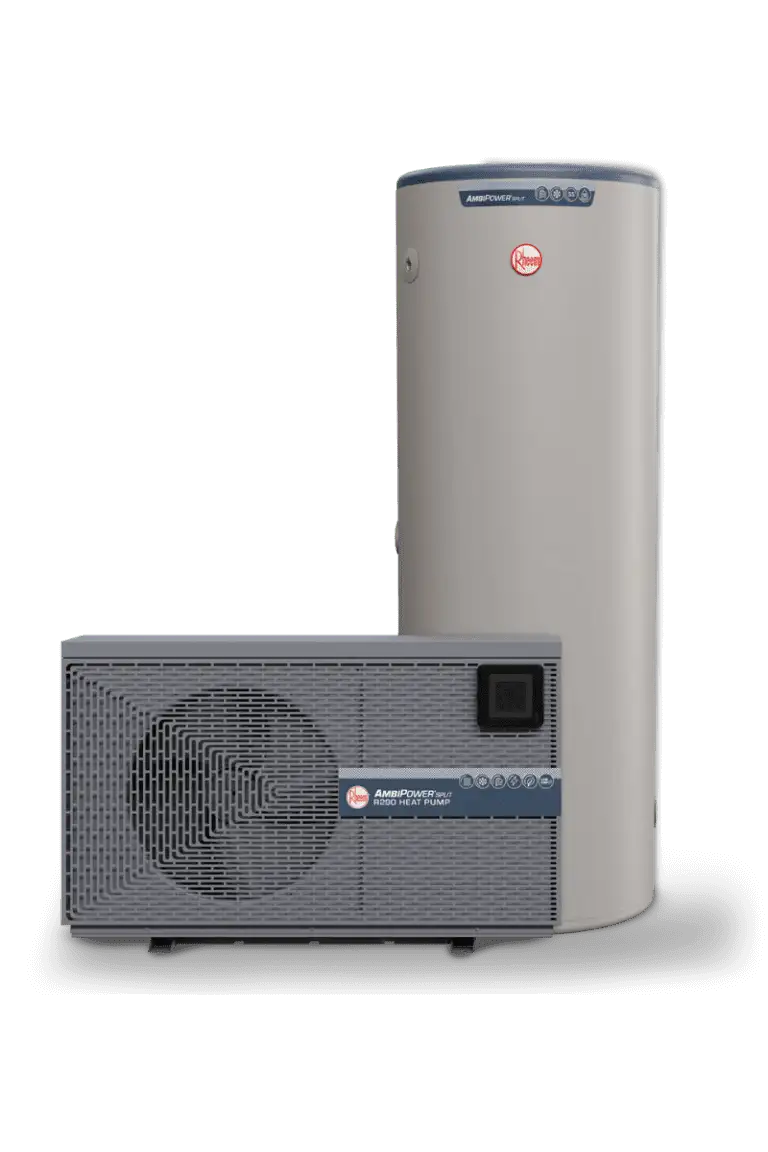
The AmbiPower 5kW Split System is Rheem’s high-capacity and flexible heat pump solution. It separates the compact heat pump unit from the large storage tank.
This helps it address installation challenges and delivers powerful hot water recovery using the superior R290 refrigerant.
Specifications: AmbiPower 5kW Split Heat Pump System
What we like about the AmbiPower 5kW Split Heat Pump System
What could be better
✔️ Best for: Large households (4–6 people) seeking maximum installation flexibility, high hot water capacity/recovery and the strongest system for cold climates where full frost protection and a long tank warranty are non-negotiable.
One thing Rheem did right with the AmbiPower series is the control panel.
It doesn’t feel confusing.
You don’t sit there thinking, “Which button is going to break something?” Instead, the system gives you a handful of modes that fit real-life situations.
You pick what you want, and it does the rest.
Here’s how each one works.
This is the mode most people leave it on, and honestly, you can run the system for years without touching anything else.
It leans on the heat pump to do most of the work, which keeps your running costs low.
If things get chilly outside or you suddenly need a quick boost, the electric element steps in.
You get solid efficiency without stressing about running out of hot water. It’s very much a “just let it do its thing” setting.
This one is for people who want the absolute lowest running cost and are happy to trade a bit of speed for it.
The electric element sits out completely.
Everything runs off the compressor. Great if you’ve got solar and want the tank heating in the middle of the day while the sun is doing the heavy lifting.
Just know it heats slower, so back-to-back showers might push it.
Imagine visitors staying over, kids having long showers, washing machine running non-stop — chaos. This mode is for that.
Both the heat pump and the electric element fire up together, so the tank refills fast. It’s the quickest way to recover the whole system when you know you’re going to be using a lot of hot water.
This one feels like a throwback. The heat pump turns off, and the unit heats water the old-school way — straight electricity.
It’s quick but expensive to run.
Most people only use it in a pinch, like if the weather is freezing or something needs a top-up urgently.
If you’re heading out for a few days or longer, this mode keeps the tank warm enough to stay safe while cutting down on your power use.
It doesn’t heat water you’re not going to use. Once you’re back, switching out of this mode sends it right back to normal operation. It’s that simple.
If you’ve been wondering whether a Rheem heat pump is worth the money, the short answer is: most people end up saving more than they expect.
The savings show up in two places — what you spend up front, and what you keep in your pocket every year after.
Let’s break this down.
The biggest shift happens once the system is running. Heat pumps use far less electricity than old electric tanks. In some homes, it’s close to 70% less. That’s massive.
On average, most households keep around AUD500–AUD550 a year that would’ve gone straight to the power company.
Some save more, especially if they’re on the higher end of electricity rates or have a busy household that chews through hot water.
Yes, heat pumps cost more upfront than a basic electric tank. Everyone knows that part. But those yearly savings slowly chip away at the price difference.
Most homes hit the break-even point in three to seven years, depending on hot water usage and local energy rates.
After that, it’s just pure savings every year the unit keeps working.
A lot of homeowners in Australia don’t realise how many financial incentives are available. And they stack.
If your Rheem model meets the required efficiency standards, you can get up to AUD2,000 back on your taxes. That instantly knocks a big chunk off the purchase.
Depending on where you live, your state or even your local utility might offer additional rebates for upgrading to an efficient system.
These vary a lot, but sometimes they’re hundreds of dollars on top of the federal credit.
Put everything together, and the upfront cost can drop far lower than what people assume.
In some cases, homeowners find that the rebates bring the total cost close to — or even below — a traditional electric tank install.
Australia’s climate is all over the place. You’ve got humid summers up north, icy mornings down south, and everything else in between.
Rheem clearly had that in mind when they built the AmbiPower range because these units aren’t picky about where they live.
Let’s start with the colder states.
Anyone in Victoria or Tasmania knows winter can hit hard, and many heat pumps struggle once the temperature drops.
The R290 models — like the AmbiPower 280e and the 5kW Split — handle low temperatures far better than older designs.
They’re rated to keep running efficiently even when the air outside hits –6°C, which is seriously impressive.
Why does that matter?
It’s because the colder it gets, the more other systems rely on their electric element. That electric element is the expensive part to run.
The better the heat pump performs in the cold, the more money you keep in your wallet. Simple as that.
Now swing over to Queensland or Western Australia, where it feels like summer lasts ten months of the year. Heat pumps absolutely thrive in these areas.
With so much warm air to work with, the AmbiPower units often reach a COP above 5.2. Simply, the system makes a lot of hot water for very little electricity.
This is where people with solar really win. The heat pump runs almost effortlessly, heating the tank fast while your panels handle the bulk of the work.
No matter the climate, Rheem keeps things stable. Every model includes the controls needed to maintain water at 60°C, which is the sweet spot for safety and for preventing bacterial issues.
And they do it without chewing through electricity like an old electric tank would.
The insulation is thick, the temperature controls are reliable, and everything feels like it was built with long-term use in mind.
Replacing an existing electric storage unit with an AmbiPower heat pump is designed to be a straightforward process for certified Rheem installers.
These are the simple ones. Everything is built into a single outdoor unit, so most of the time it’s a straight replacement.
The installer disconnects your old tank, slides the new one in, hooks up the same plumbing and electrical lines, and that’s all.
These take a little more coordination.
However, they also give you more flexibility. The heat pump sits outside, and the tank can go indoors or somewhere more tucked away.
You’ll usually have a plumber handling the tank and water lines and a refrigeration tech running the refrigerant piping to link the two parts.
It’s a bit more involved, but it solves the “I don’t have space for a giant cylinder outside” problem that many homes run into.
One thing every heat pump needs is space to breathe. The unit has to pull in warm air and push out cooler air.
If it’s crammed into a tight corner or boxed in behind fencing, it won’t run efficiently.
Installers make sure there’s enough open space around it so it can do its job without recycling its own cold exhaust air.
The Australian heat pump market is highly competitive, featuring both integrated (all-in-one) and split systems.
Rheem AmbiPower distinguishes itself by balancing near-top-tier efficiency with unrivalled national support and reliability.
Here is how the Rheem AmbiPower compares against key competitors:
| Feature | Rheem AmbiPower 280e | Sanden Eco Plus | iStore | Thermann Integrated |
| Refrigerant | R290 | R744 | R290 | R290 |
| COP | Up to 5.2 | 5.96 | ~4.8 | ~4.6 |
| Noise (dB) | 47 | 37 | ≤46.6 | 37 |
| Tank (L) | 280 | 160-315 | 180/270 | 200/285 |
| Warranty | 7 years tank/ 3 years | 6-10 years pump/ 15 years tank | 5 years parts 7 labour | 7 years tank/ 3 years system |
The upfront price still limits some people from buying. But once the rebates kick in, the final cost looks a lot friendlier.
With the federal credits and what many states offer, you end up paying far less than expected. For what the system delivers, the value is genuinely solid.
This is where Rheem really shines. The warranty is generous—up to 10 years on the tank—but the real winning piece is their service network.
If something goes wrong, there’s almost always someone close by who can fix it without leaving you waiting for weeks.
A lot of heat pumps start struggling once the temperature drops, but this one keeps going.
It handles cold mornings down to -6°C without leaning too hard on the electric backup. Recovery times stay strong, too, so households don’t end up running out of hot water just because it’s winter.
This unit sits near the top of the efficiency chart. With a COP up to about 5.2, it turns a tiny amount of electricity into a surprising amount of hot water.
Over the years, that adds up to real savings—honestly, one of the biggest reasons people switch in the first place.
Yes, the Rheem AmbiPower Heat Pump is an outstanding long-term investment for the vast majority of Australian households.
The worth of the system is proven through two major factors.
Financially, the AmbiPower’s COP ≤ 5.2 drives energy savings of up to 73% on your hot water bill.
This means the investment is often paid back within 3 to 7 years through savings alone, generating pure profit for the remainder of its life.
Operationally, the value lies in reliability. Choosing Rheem guarantees you are backed by the largest service network in the country.
You get a product built for Australian extremes with excellent cold-weather performance and a long-life cylinder warranty, ensuring minimal downtime and maximum peace of mind.
If you’re serious about cutting your energy bills and want hot water you can rely on, the Rheem AmbiPower heat pump is a solid pick.
Yes, the upfront cost is higher than a standard electric tank. But once you factor in rebates, federal incentives, and the long-term energy savings, the numbers start looking really good.
It’s not just about money, either.
Rheem has been in the Australian hot water game for over 85 years, so you’re getting a system built for local conditions.
Add in the nationwide installer network and long cylinder warranty, and you’ve got a setup that’s designed to last, with support you can actually count on.
It depends a bit on the model, how cold your water starts and the temperature outside. Generally, for a 280L tank in Energy Saver Mode, heating from around 15°C to 60°C can take anywhere from 4 to 8 hours. On warmer days, it’s quicker.
Yes. The unit pulls warmth from the air, so sunlight isn’t required. It’s built to handle cold conditions, operating efficiently down to –6°C. If it gets colder than that or you need hot water in a hurry, the backup electric element kicks in automatically, so you’re never left with a cold shower.
Technically, yes. The heat pump still needs to be connected to the grid, but you can use the Timer Function to heat water during peak solar hours—say, 10 am to 3 pm. This way, most of the electricity comes from your solar panels. Your meter barely notices, and your power bill definitely will.
Surprisingly quiet. Integrated units usually run at about 47dB, which is like a fridge humming in the background. You’ll hear it, but it’s not disruptive, especially if it’s installed with some space around it. In most cases, it blends into the backyard background noise rather than standing out.
With a little care, these units last a long time. The tank comes with a 7–10 year warranty depending on the model, and the system itself usually runs strong for 10–15 years. So, it’s definitely a long-term upgrade rather than a short-term fix.
Yes, an annual check is a smart move. A qualified plumber or refrigeration tech usually handles it. They’ll check the refrigerant (for split systems), clean the evaporator coil to keep airflow smooth, inspect the condensate drain, and check the anode if your tank has one. It’s a quick job that keeps your system efficient and happy for years.
Quick Answer To replace your hot water system under the NSW Home Energy Saver loan for hot water, first check […]

If you’ve been longing to upgrade your home’s energy efficiency but held back by the upfront cost, this could be […]

The need for hot water in Australian homes has changed a lot over the last decade. Showers are longer. Appliances […]